
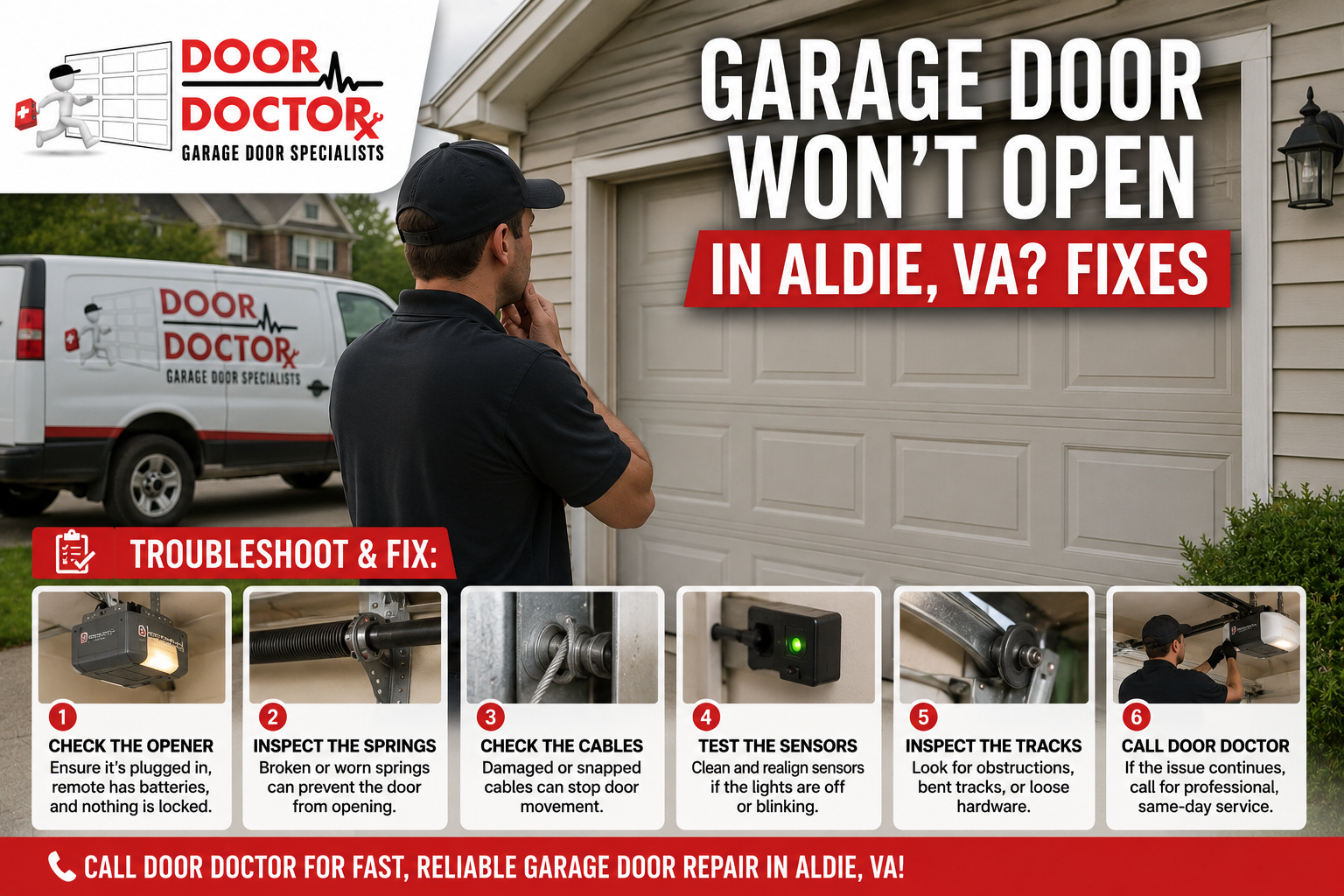
What to Do When Your Garage Door Won’t Open in Aldie, VA
Quick Answer: Check that the opener has power, test the wall button, replace the remote batteries, unlock the door, and make sure the emergency release has not disconnected the opener. If the door is crooked, unusually heavy, rises only a few inches, or the motor runs without moving it, leave it closed and arrange an inspection.
Check the Power and Controls
Start by making sure the opener is plugged in. Check the circuit breaker and reset any nearby GFCI outlet with “Test” and “Reset” buttons. A storm, power surge, or overloaded circuit may interrupt power to the opener.
Next, press the wall button inside the garage. If it works but the remote does not, replace the remote batteries or follow the manufacturer’s instructions to reprogram it. If neither control responds even though the opener has power, the problem may involve the wall-control wiring, control board, motor, or another opener part.
Comparing the two controls can help narrow down the issue. A working wall button usually points to the remote, while two unresponsive controls may indicate a broader electrical or opener problem.
Check the Lock and Emergency Release
Some garage doors have a slide lock or manual locking handle. If the lock is engaged, the opener may hum or strain because the door cannot move. Release the lock fully before testing the opener again.
The red emergency-release cord disconnects the door from the opener. It may have been pulled during a power outage or when someone moved the door by hand. When the carriage is disconnected, the motor may run while the door remains still.
If the door is fully closed, straight, and undamaged, follow the opener manufacturer’s instructions to reconnect it. The correct steps vary by model. Do not reconnect or move a door that is open, crooked, off track, or visibly damaged.
Use the Sound and Movement as Clues
The way the door responds can help separate a power or control issue from a mechanical problem.
| What You Notice | What It May Mean | What to Do |
| No lights or sound | Power loss, faulty outlet, or opener problem | Check the power supply |
| Wall button works, but remote does not | Weak battery or lost programming | Check the remote |
| Motor runs, but the door stays still | Disconnected carriage, worn opener part, or lifting-system damage | Stop operating the door |
| Humming without movement | Locked, stuck, or unusually heavy door | Arrange an inspection |
| Door rises a few inches and stops | Spring, cable, or track problem | Leave the door closed |
| One side rises higher than the other | Cable, roller, track, or spring damage | Do not operate the door |
Grinding, smoke, or a burning smell may indicate an electrical or mechanical failure. Turn off the opener rather than continuing to test it.
Inspect the Springs, Cables, Tracks, and Rollers
The springs support much of the door’s weight, while the cables help it rise evenly. Problems with the tracks or rollers can also cause the door to bind, tilt, or stop partway.
From a safe distance, look for a visible gap in the spring, a loose or frayed cable, a bent track, loose brackets, displaced rollers, or one side of the door sitting lower than the other. These signs point to a problem with the door’s lifting or guiding system rather than the remote or power supply.
You may remove loose leaves or surface debris while the door is closed. Do not pull a cable, adjust a spring, push a roller back into place, or try to straighten a bent track. Springs and cables may remain under high tension, so adjustments and replacement should be left to a trained technician.
Check for Ice or a Sticking Bottom Seal
Cold mornings in Aldie can cause moisture beneath the bottom seal to freeze to the garage floor. Northern Virginia temperature changes and summer humidity may also make an older seal sticky, swollen, cracked, or uneven.
Clear visible ice, mud, leaves, and other buildup before testing the opener. Do not use the motor to pull a frozen door free. If the seal regularly sticks or no longer rests evenly against the floor, it may need replacement.
Is It Safe to Open the Door by Hand?
Only attempt manual operation when the door is fully closed, straight, and free of visible spring, cable, roller, or track damage.
Follow the manufacturer’s instructions to disconnect the opener, then lift the door slowly with both hands. Stop if it feels unusually heavy, pulls to one side, drops, or becomes difficult to control. These signs suggest that the door may not be properly balanced.
Do not manually lift the door simply to test whether a visibly damaged spring or cable still works.
When Should You Stop Troubleshooting?
Homeowners can generally check the power supply, remote batteries, wall control, manual lock, emergency-release connection, loose debris, and visible ice.
Professional inspection is appropriate when the door is crooked, off track, unusually heavy, moving unevenly, or unable to move normally after these basic checks. A visible spring gap, hanging cable, displaced roller, grinding opener, smoke, or burning smell also indicates that the problem goes beyond basic troubleshooting.
What a Professional Inspection May Include
A garage door that will not open does not always have an opener problem. The cause may involve the controls, opener connection, door balance, springs, cables, rollers, tracks, sensors, or another part of the lifting system.
A technician may inspect how the opener responds, whether the door moves evenly, and whether the springs and cables are supporting the door correctly. Looking at the door and opener together helps prevent a control problem from being mistaken for mechanical damage. It also helps prevent mechanical damage from being treated as a simple opener failure.
Door Doctor VA states that its technicians are trained, experienced, insured, and part of its in-house service team.
Garage Door Repair in Aldie, VA
Door Doctor VA is a family-owned and locally operated company that has served Northern Virginia since 1989. Its Aldie garage door repair services cover problems involving openers, springs, cables, rollers, tracks, sensors, weather seals, and damaged door sections.
If the basic checks do not identify the problem, a technician can inspect the complete system, explain what is preventing the door from moving normally, and discuss the available repair options.
Frequently Asked Questions
Schedule Garage Door Service in Aldie, VA
If your garage door won’t open in Aldie, VA after the basic checks, call Door Doctor VA at (703) 709-7933 to arrange an inspection. Same-day service may be available for urgent problems, but appointment availability should be confirmed when scheduling.