
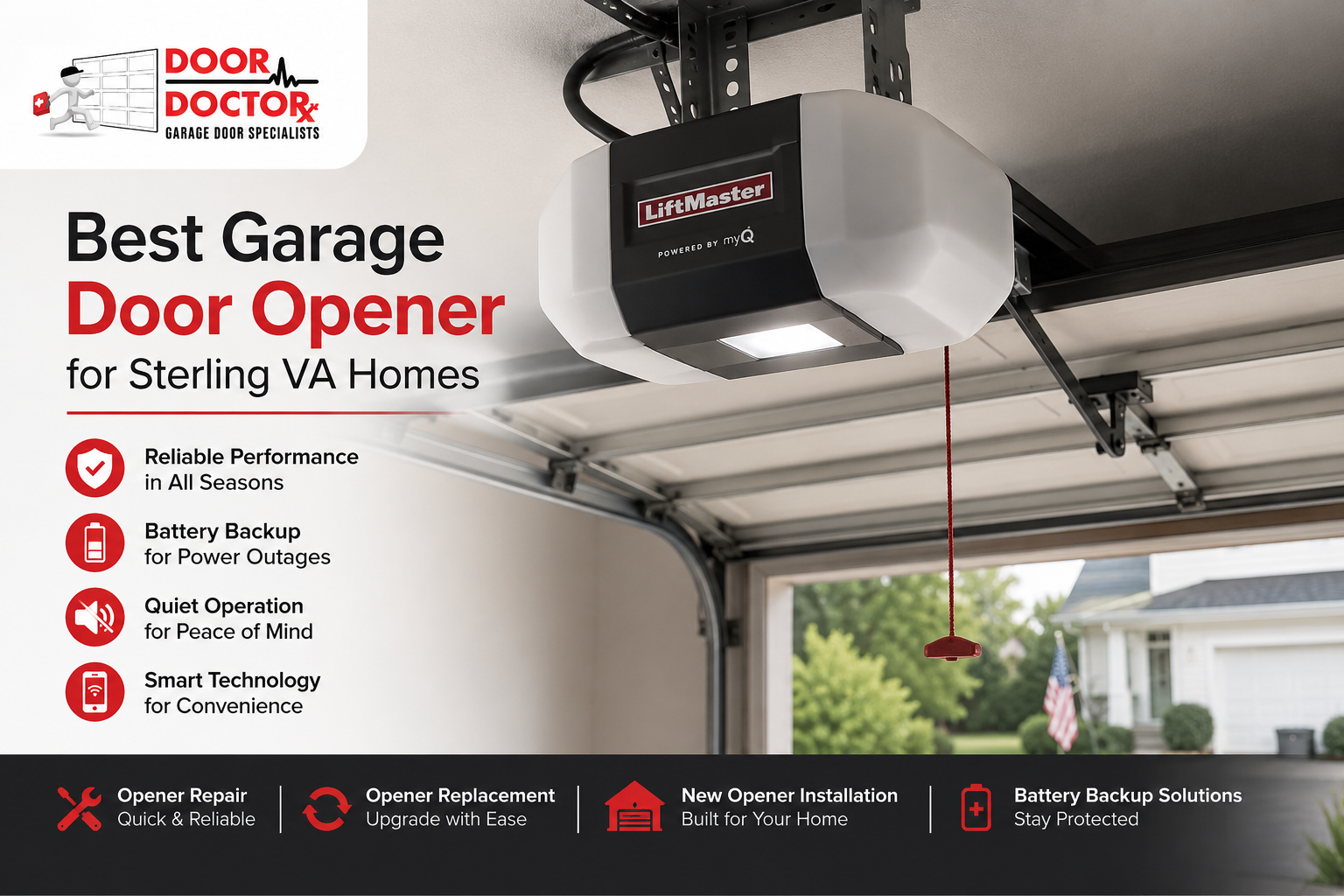
Which Garage Door Opener Is Best for Sterling, VA Homes?
Quick Answer: For many attached Sterling garages, a belt drive opener with battery backup is a practical choice because it runs quietly and can operate during a short power outage. The right model should also match the door’s size, construction, condition, garage layout, and daily use.
Start With the Garage Door
The quietest, strongest, or most expensive opener is not automatically the best choice. The right model depends on where the garage is located, how often the door is used, how much noise the household can tolerate, and whether the door is in good working condition. A belt drive is often practical for an attached garage, especially when a bedroom, office, or living area is beside or above it. A direct drive may also suit homes where low noise and vibration matter. A chain drive is generally louder, but it can be durable and more affordable, making it a reasonable choice for a detached garage where sound is less likely to disturb people inside the home.
The opener should move the door smoothly without having to compensate for worn or damaged parts.
Best Opener by Garage Type
| Garage or Door Type | Opener to Consider | Why It May Fit |
| Attached garage | Belt drive | Quieter near bedrooms and living spaces |
| Low-noise or low-vibration priority | Direct drive | Smooth operation with reduced vibration |
| Detached garage | Chain drive | Durable and often more affordable |
| Heavy, insulated, wood, or custom door | Higher-capacity model chosen after an inspection | Door weight and construction affect compatibility |
| Garage used as a main entrance | Battery-backup model | Can operate for a limited time during an outage |
This table provides general guidance. The final choice should follow the opener manufacturer’s compatibility requirements and the actual condition of the garage door.
Belt Drive vs. Chain Drive Garage Door Openers
A belt drive uses a reinforced belt instead of a metal chain and usually creates less noise and vibration, which can make it a better fit for an attached garage. A chain drive uses a metal chain to move the door. It is common, durable, and often less expensive, but it typically produces more sound.
For example, a household with a bedroom above the garage may prefer a belt drive, while a chain drive may be suitable for a detached garage used mainly for parking or storage. Neither option is best for every home. Garage location, budget, noise tolerance, and door condition should guide the decision.
Is a Direct Drive Opener a Good Choice?
A direct drive opener is designed for smooth movement with fewer moving parts in the drive system. It may suit a garage near a bedroom, home office, or another quiet area. However, there may be fewer direct drive models available than belt or chain drive options, so homeowners should compare the warranty, replacement-part availability, service options, and compatibility with the garage door before choosing one.
How Door Size and Construction Affect the Choice
Garage door openers use different motor or lifting-capacity ratings. Many standard residential doors work with an opener in the common 1/2-horsepower range or an equivalent manufacturer rating, while heavier insulated, wood, double-car, oversized, or custom doors may require a higher-capacity model.
Horsepower alone should not determine the choice. The opener must also suit the door’s weight, height, construction, condition, and manufacturer requirements. The springs should carry most of the door’s weight, so a stronger opener should not be used to force a door with weak springs, damaged cables, binding rollers, or poor alignment.
Why Battery Backup Can Matter in Sterling
Battery backup allows the opener to work for a limited time when household electricity is unavailable. It may be useful during thunderstorms, high winds, winter weather, or utility interruptions, especially when the garage is the main household entrance, a vehicle is parked inside, or there is no easy second way into the space.
The battery requires periodic testing and eventual replacement, so homeowners should follow the manufacturer’s care instructions. Battery backup is an added feature rather than a separate drive type and may be available with belt, chain, or direct drive systems.
Smart Features and Daily Convenience
Smart features may allow homeowners to check the door’s status, receive alerts, manage temporary access, or close the door from a phone. These tools can help someone confirm that the garage is closed, receive a notice when it opens, or provide temporary access while away from home.
Before purchasing a smart opener, confirm that it works with the home’s Wi-Fi, mobile device, and preferred smart-home system. Use a secure password and install software or app updates when available. Smart controls add convenience, but they do not replace working safety systems or proper installation.
Safety Features to Look For
A residential opener should have working photo-eye sensors and an automatic reversal system. These features help stop or reverse the door when an obstruction is detected. Photo-eye sensors are installed near the bottom of the garage opening, and dirt, moisture, loose brackets, damaged wiring, or poor alignment can interrupt the sensor beam.
When comparing openers, also review the manufacturer’s safety instructions, control security, lighting, manual-release design, and compatibility with the existing door. Repairs involving springs, cables, or other high-tension parts should be left to a qualified garage door professional.
Check the Door Before Replacing the Opener
A slow, noisy, or struggling opener does not always mean the motor has failed. A worn spring, damaged cable, rough roller, bent track, or alignment problem can place extra strain on the system. Because the opener and door work together, an evaluation may include the door’s movement, hardware, sensors, controls, wiring, and opener operation.
This can show whether the opener needs repair or replacement, or whether another part of the door is causing the problem. For example, an opener may sound weak because worn hardware is making the door harder to move. Correcting the door problem may reduce the strain without requiring a new opener.
Should You Repair or Replace the Current Opener?
Repair may be appropriate when the problem involves one component, such as the remote, wall control, sensor, wiring, gear, backup battery, or settings. Replacement may be more practical when the opener struggles after the door has been checked, works inconsistently, has become unusually loud, needs frequent repairs, or has parts that are difficult to obtain.
A newer opener may also be worth considering when the existing unit lacks working photo-eye sensors, automatic reversal, suitable security features, or access options the household needs. The decision should be based on the condition of the complete system rather than the age or sound of the opener alone.
What a Professional Evaluation Can Show
A professional evaluation considers both the opener and the garage door. Depending on the problem, a technician may inspect the door’s movement, springs, cables, rollers, tracks, hinges, safety sensors, automatic reversal, wall controls, remotes, wiring, power supply, and opener operation.
The technician may also consider the door’s size and construction, the garage layout, and whether the system is compatible with battery backup or smart features. The exact inspection process may vary based on the symptoms and equipment. The goal is to identify the source of the problem and determine which repair or replacement options are compatible with the door.
Garage Door Opener Service in Sterling, VA
Door Doctor VA is a family-owned and locally operated garage door company serving Sterling and other Northern Virginia communities. The company provides garage door opener repair, replacement, and installation and works with major opener makes and models.
Before recommending an opener, a technician can review the current equipment, inspect how the door operates, and explain which options are suitable for the garage and household needs. This allows homeowners to compare repair and replacement options without relying only on price, motor rating, or added features.
Frequently Asked Questions About Garage Door Openers in Sterling, VA
Call Door Doctor VA for Garage Door Opener Service
If you are unsure which opener fits your Sterling home, Door Doctor VA can evaluate the garage door and current opener, review the system’s condition, and explain compatible repair or replacement options.
Call Door Doctor VA at (703) 709-7933 for garage door opener repair, replacement, or installation in Sterling and throughout Northern Virginia.